The Self-Reliance Initiative’s
Narrative Theory of Change
Introduction
Definition and scope of the Self-Reliance Initiative’s ToC:
The Self-Reliance Initiative’s Theory of Change (ToC) maps the pathway from the issue that the program addresses to the change that we seek to contribute to bringing about, along with the assumptions made along the way. This will explain how and why the program’s activities are expected to lead to a meaningful, long-term impact to empower families, supported by No End To Love, to move from surviving to thriving.
The focus is on the Self-Reliance Initiative’s programming only. It is not the intention of this ToC to include outcomes of other interventions in addressing systemic poverty and lack of education in our target population. However, the presence of key related interventions — as well as other key factors and actors that influence the achievement of our objectives — is considered in our assumptions.
Please note that this ToC, like all ToCs, illustrates a simplified and sequential process of achieving the desired outcomes. But individual and social change do not necessarily happen as neat and linear transformations. Some changes happen simultaneously — and may also be mutually reinforcing and interconnected — and some may be influenced by factors that we have not (yet) accounted for. The ToC cannot fully capture such complex causal dynamics, systems, and processes.
The process by which the Self-Reliance Initiative’s Theory of Change was developed:
Initial discussions between the founders and No End To Love’s community representatives in Kenya focused on how to help sponsored families achieve self-reliance. The aim was to enable these families to meet basic needs, generate income, and pay school fees for their children. Input from potential funders was also gathered to ensure the initiative met necessary requirements.
Purpose of the Self-Reliance Initiative’s ToC:
The Self-Reliance Initiative’s ToC is designed to build a common understanding among the program team and program partners on the core objective of the Self-Reliance Initiative’s programming, which is to: Promote Self-Reliance within families and communities. It thus helps maintain focus and ensure accountability and program quality, while simultaneously helping us navigate the evolving processes and changing contexts in which our program operates.
The program team sees the ToC as a living document and will actively use it and continue to refine it based on further evidence and learning, thus ensuring the Self-Reliance Initiative’s strategic relevance. We believe the ToC is not an endpoint but a starting point for the change we want to see.
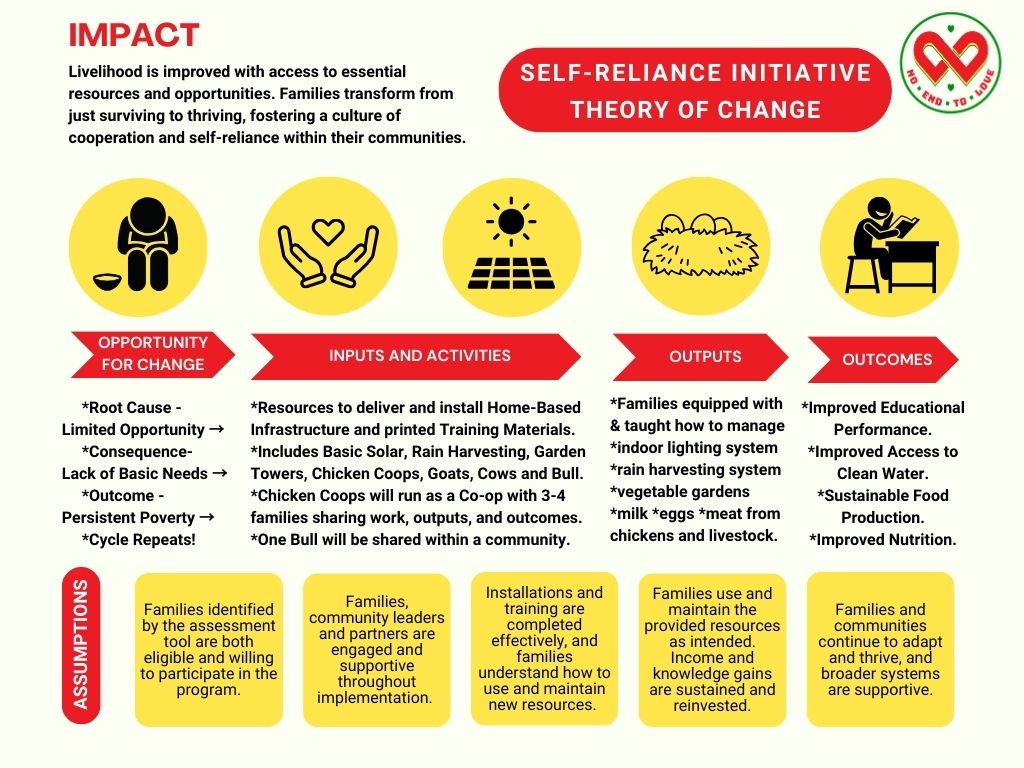
NARRATIVE THEORY OF CHANGE
OPPORTUNITY FOR CHANGE - THE PROBLEM
Many families in rural communities in Kenya as well as urban slums find themselves caught in the Persistent Poverty Cycle. The cycle begins with limited opportunities, which stem from systemic barriers that prevent individuals or communities from accessing essential resources like education, employment, healthcare, and social mobility. These barriers may be caused by economic inequality, discrimination, poor infrastructure, political instability, or historical marginalization.
Without these opportunities, individuals are unable to improve their circumstances, leading to a lack of basic needs. As a result of the lack of opportunity, they cannot earn enough income or access resources to meet essential needs such as food, clean water, shelter, healthcare, and education. This deprivation reinforces poverty, making it increasingly difficult to escape and creates a feedback loop.
The outcome is persistent poverty, a long-term result of sustained lack of opportunity and unmet basic needs. This form of poverty becomes entrenched across generations, characterized by intergenerational poverty, chronic unemployment, poor health outcomes, and low educational attainment. Breaking this cycle is crucial for improving lives and fostering a more equitable society.
Limited opportunity and persistent poverty are daily realities for the families supported by No End To Love in Kenya. The root of these challenges lies in a widespread lack of infrastructure and essential services—families often struggle to access clean water, nutritious food, safe shelter, and quality education. The burden of daily survival tasks, such as water collection (often falling to school-age girls), consume valuable time and energy. The lack of basic human needs not only impedes survival but also prevents families from envisioning a more prosperous future.
The underlying causes of this hardship are complex. Systemic poverty is fueled by insufficient government and societal infrastructure, a lack of formal education among parents, and family structures—such as single-parent or polygamous households—that face unique economic pressures. Without reliable public support or access to resources, families are left to navigate these challenges alone, often unable to break free from the cycle of poverty.
The consequences are far-reaching. Children’s education is disrupted, health and nutrition suffer, and families remain focused on survival rather than growth. Hope for a better future is diminished, and opportunities for economic advancement are limited. Recognizing these realities, the Self-Reliance Initiative seeks to address the immediate needs of the families by helping them build local, home-based infrastructure.
This in turn assists them in overcoming the systemic barriers. The initiative provides participating families with the basics of life and the means to create different income streams, allowing them to put food on the table, pay school fees for their own children and move towards self-reliance and hope for the future.
THE SELF-RELIANCE INITIATIVE’S PROGRAM - INPUTS & ACTIVITIES
The Self-Reliance Initiative, supported by No End To Love, is a comprehensive program designed to empower families in Kenyan communities to move from surviving to thriving. Through a phased, home-based approach, the initiative provides families with essential resources such as solar lighting, rainwater harvesting systems, home gardens, poultry, and livestock. By combining practical tools, training, and ongoing support, the program enables families to meet their basic needs, develop new skills, and create sustainable sources of income. Ultimately, the Self-Reliance Initiative aims to foster lasting self-sufficiency, resilience, and hope for a brighter future.
Inputs
Funding to run the program, which includes MEL procedures implemented during each phase to gather information and adjust programs if necessary based on the evidence.
PPI Assessment tools; Criteria for program eligibility determined by score on vulnerability assessment tools, based on the Poverty Probability Index (PPI)
Technology - Tablets for portable accessibility to Assessment Tools
Skilled Staff - Social Worker, Agricultural Specialist, Community Development Coordinator, Carpenter and Building Coordinator, Animal Husbandry Specialist, Community Representatives
Educational Materials and Guidance for each phase of the initiative.
Materials needed for each program phase
Phase 1 - Basic 80-Watt Home Solar Lighting System with battery and accessories.
Phase 2 - 2000 Liter Rain Harvesting System with gutters and accessories, 1 water filter.
Phase 3 - 2 Garden Towers with seedlings, watering tube and other accessories.
Phase 4 - Chicken Coop with five Chickens and one Rooster and ten tree seedlings.
Phase 5 - 2 Goats per household, one female and one male.
Phase 6 - 1 Cow per household with one bull for breeding per community.
Activities
Before the Self-Reliance Initiative is implemented, a meeting will be held with participating community members. This meeting, led by the Community Development Coordinator, the Community Representative for No End To Love, and local community leaders, will introduce The Self-Reliance Initiative to families and clearly explain its purpose. During the session, both the responsibilities and expectations of the families, as well as the contributions and commitments of No End To Love, will be outlined. Families will then confirm their understanding and agreement to these responsibilities in order to participate in the program.
The Chicken Coop is run as a community co-op and this meeting is also an opportunity to identify neighboring families that will work together to manage the coop, both expenses and income created from the resources. A bull will be shared by each community for breeding purposes and how the responsibility of the bull will be handled will also be discussed at the community meeting. Both these situations will foster cooperation within the community.
Throughout each phase of the Self-Reliance Initiative, installation, education and hands-on training are essential components. For every project—whether it’s setting up solar lighting, installing rain harvesting systems, building garden towers, or introducing poultry and livestock—families receive not only the necessary materials but also practical instruction on use, maintenance, and care. This approach ensures that families are equipped with the knowledge and skills needed to sustain each new resource, maximize its benefits, and build lasting self-reliance.
THE SELF-RELIANCE INITIATIVE OUTPUTS
With the implementation of the Self-Reliance Initiative, families will immediately notice significant improvements in their daily lives. The solar lighting system will illuminate homes, enhance safety and extend productive hours after sunset. The rain harvesting system ensures a reliable supply of water for cooking, cleaning, and drinking, reducing dependency on external sources. Fresh vegetables from garden towers will enrich family meals with nutritious produce. The chicken coop will offer a steady supply of eggs and poultry meat, improving the family's nutrition with the addition of high-quality protein. Shade trees will provide a cooler environment for both the coop and family gatherings. Additionally, goats and cows will contribute fresh milk to family meals. Training materials will equip families with the knowledge needed for the sustainable upkeep of these assets, promoting long-term self-reliance.
THE INTENDED OUTCOMES
While outputs represent the immediate, tangible products of our program—such as solar lighting systems, rainwater harvesting units, garden towers, and livestock—these alone do not create lasting change. The true impact of the Self-Reliance Initiative emerges as families begin to use and maintain these new resources in their daily lives. As families integrate these outputs, they experience meaningful improvements: children have more time to study, families enjoy better nutrition, and households gain new skills and confidence. These changes, or outcomes, are the direct result of the program’s inputs and outputs (resources and training) being put into practice. This demonstrates how the provision of resources, combined with hands-on training, leads to real and lasting benefits for families and communities.
- Improved Educational Performance:
Short-Term: Families utilize solar lighting systems for safe and reliable indoor lighting, allowing children to study and adults to perform tasks during the evening.
Intermediate: Enhanced study time for children and productive evening activities for adults lead to better educational outcomes and increased household productivity.
Long-Term: Improved education and productivity foster self-reliance and economic empowerment within communities.
- Improved Access to Clean Water:
Short-Term: With rain harvesting systems, families gain onsite access to water for essential activities such as cooking, cleaning, drinking, and gardening.
Intermediate: The reduction in time and effort spent on water collection, particularly for girls, allows for participation in educational and economic activities.
Long-Term: Consistent access to water improves health and hygiene, supports sustainable food production, and enhances overall quality of life.
- Sustainable Food Production for Economic Stability and Improved Nutrition:
Short-Term: Families enjoy better nutrition by incorporating fresh vegetables, milk, and eggs into their diets due to the addition of garden towers, chickens and livestock.
Intermediate: Surplus produce from garden towers and surplus livestock products such as milk and eggs are sold or traded, providing families with additional income.
Long-Term: Gardening and animal care skills improve food production to ensure long-term nutrition and economic stability for families. Livestock herds are a traditional marker of wealth and status in Kenyan society.
THE DESIRED IMPACT
By providing families with essential resources and opportunities, their livelihood will improve and they move from merely surviving to truly thriving. As families achieve self-reliance, they will share their skills and foster a culture of cooperation within their communities. When families are equipped to meet their basic needs, they are empowered to pursue self-reliance and flourish.
CRITICAL ASSUMPTIONS
1. Opportunity for Change → Program Inputs
Families identified by the assessment tool are both eligible and willing to participate in the program.
The local context (community dynamics, safety, and infrastructure) supports program implementation.
2. Program Inputs → Activities
Families, community leaders and partners are engaged and supportive throughout implementation.
Sufficient funding, materials, and labor are available when needed.
3. Activities → Outputs
Installations and training are completed effectively, and families understand how to use and maintain new resources.
Materials and equipment are appropriate for local conditions and function as intended.
4. Outputs → Short-Term Outcomes
Families consistently use and maintain the provided resources as intended.
No major disruptions (such as drought, disease, or theft) prevent families from benefiting from the resources.
5. Short-Term Outcomes → Intermediate Outcomes
Improvements in daily life (study time, nutrition, water access) lead to increased income and educational attainment.
Local markets remain stable and accessible for families to sell animals and surplus produce.
6. Intermediate Outcomes → Long-Term Outcomes
Income and knowledge gains are sustained and reinvested, enabling families to achieve self-reliance.
Families and communities continue to value and prioritize education, health, and collaboration.
7. Long-Term Outcomes → Impact
Families and communities continue to adapt and thrive, and broader systems are supportive.
Program benefits are maintained over time, even as external conditions change.
REFERENCES:
The program’s Theory of Change is supported by evidence drawn from the following references:
Conway, N. (n.d.) From Survive to Thrive:Maslow’s 5 Levels of Human Need. Blanchett House. https://blanchethouse.org/5-levels-of-human-needs/
The 5 Things That Every Human Needs To Live. (n.d.) Basic Knowledge 101. https://basicknowledge101.com/subjects/big5.html
Quora. (2018, 02, 05) Six Fundamental Human Needs We Need To Meet To Live Our Best Lives. https://www.forbes.com/sites/quora/2018/02/05/six-fundamental-human-needs-we-need-to-meet-to-live-our-best-lives/
Carita, Connie. ( 2025, 01, 25) Why the Poor Stay Poor, Understanding the Cycle of Poverty. Medium https://medium.com/@conniecarita/why-the-poor-stay-poor-e9e3d6a17a79
Bloxham, Lucy (2023, 06, 19) The vicious cycle of poverty explained. Concern Worldwide. https://www.concern.org.uk/news/vicious-cycle-poverty-explained
Fernandez-Wulff, Paula; Osinski, Agathe; Delforge, Isabelle. (2021, 10) Persistence of Poverty, Special Rapporteur on Extreme Poverty and Human Rights. srpoverty.org. https://srpoverty.org/wp-content/uploads/2021/10/Report-Persistence-of-poverty.pdf
Outreach International (2023, 07) What is the Cycle of Poverty?. https://outreach-international.org/blog/what-is-the-cycle-of-poverty/
The hidden dimensions of poverty. (2019, 05) ATD Fourth World and University of Oxford. https://www.atd-fourthworld.org/wp-content/uploads/sites/5/2019/05/Dim_Pauvr_eng_FINAL.pdf
Africa’s Persistent Poverty Crisis. (n.d.) African Sahara https://www.africansahara.org/africas-persistent-poverty-crisis/